Mantis shrimp — the reef marvel behind cavitation physics and polarised-light vision
The mantis shrimp is a small crustacean that packs two of the most remarkable feats in biology: a strike so fast it boils the water into a light-flashing bubble, and an eye that reads colour and polarisation like no other animal. Here is the science, told for its wonder — and the bio-inspiration it fuels.
A Panacea Bio Chem field note · by Bogdan Dicoias, Scientist
· Subject: the biology of the mantis shrimp (Stomatopoda) ·
Theme: bio-inspiration for materials, imaging and gentle process physics ·
Nothing here is medical advice.
The mantis shrimp — a reef predator whose strike and eyes are studied worldwide for
bio-inspiration. A field note for Panacea Bio Chem, by Bogdan Dicoias.
In brief
The mantis shrimp (order Stomatopoda) is not a true shrimp but a distinct lineage of reef
predators. Two features make it a favourite of scientists. First, the smasher types throw a spring-loaded
club at some of the highest accelerations in the animal kingdom — fast enough to form a cavitation bubble
whose collapse emits a brief flash of light. Second, their eyes carry up to sixteen classes of
photoreceptor and can see polarised light, a design that has inspired compact hyperspectral and
polarisation cameras. This page presents the biology for its wonder, and traces where that wonder becomes
engineering inspiration. It is a beneficial scientific description, not medical advice.
Mantis shrimp — at a glance
Group
Order Stomatopoda — marine crustaceans; not true shrimp. ~450 known species
Two forms
Smashers (club-strike) and spearers (harpoon-strike)
Signature feat
A strike fast enough to trigger cavitation — and a light-emitting bubble collapse
Eyes
Up to 16 photoreceptor classes; sees linear and circular polarised light
Club material
A layered, impact-tolerant biocomposite — a model for tough materials
Why studied
Bio-inspiration for materials, optics, imaging and cavitation physics
Framing
Beneficial-science field note · nothing here is medical advice
1. What is a mantis shrimp?
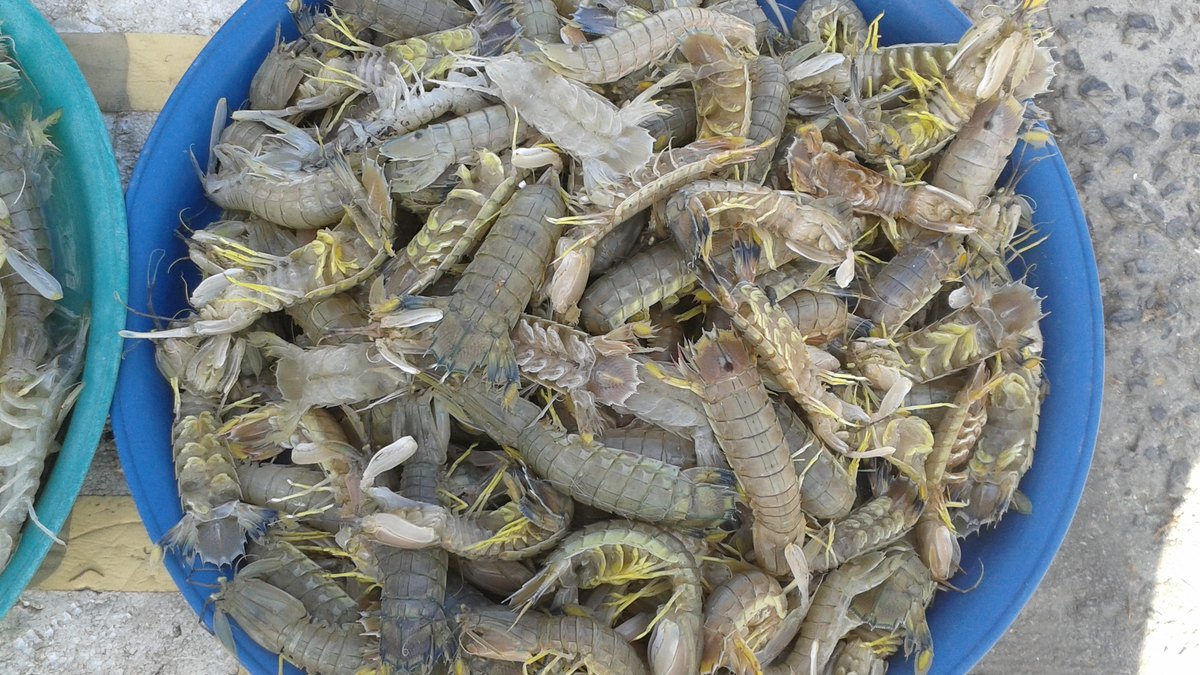
Despite the name, a mantis shrimp is neither a mantis nor a shrimp. It belongs to Stomatopoda, an
ancient order of marine crustaceans that split from other crustaceans hundreds of millions of years ago. Most
live in burrows on tropical and subtropical reefs, and there are roughly 450 described species, many of
them vividly coloured1. They come in two broad styles named for how they hunt:
spearers, which unfold a barbed forelimb to harpoon soft prey, and smashers, which carry a
hardened club to crack open snails, crabs and clams. It is the smasher that made the mantis shrimp famous.
A palm-sized reef animal that punches with a bubble of boiling water and sees a rainbow we cannot — biology rarely concentrates so much wonder in one body.
2. The strike that boils water into light
A smasher stores energy in a saddle-shaped spring in its arm, latches it, and releases it all at once. The
club accelerates so hard — comparable to a small-calibre bullet leaving a barrel — that the water immediately
behind it cannot follow, and its pressure drops low enough to vaporise. This is cavitation: a
short-lived vapour bubble in the wake of the strike. When the bubble collapses it snaps shut with a sharp
release of energy, and in laboratory recordings that collapse has been seen to emit a faint flash of
light — a phenomenon in the family of sonoluminescence2. The prey is hit
twice: once by the club, once by the collapsing bubble a heartbeat later.
For engineers, cavitation is a rich and useful branch of physics. Controlled well, the collapse of tiny
bubbles can clean surfaces, mix fluids and drive gentle, localised effects; understood well, the same physics
explains how to avoid unwanted collapse where it is not wanted. The mantis shrimp is, in effect, a living
demonstration that pressure and phase change can be marshalled with astonishing precision.
The reef that shaped it. A world of light, pressure and colour that tuned the mantis shrimp's two
signature gifts. Context for Panacea Bio Chem, by Bogdan Dicoias.
3. Eyes unlike any other
The mantis shrimp's eyes sit on stalks and move independently, each one able to judge depth on its own. Inside
are up to sixteen classes of photoreceptor — humans have three — plus receptors tuned to ultraviolet
and, uniquely among known animals, to circularly polarised light3. Curiously,
experiments suggest they do not blend these channels into fine colour discrimination the way we do; instead they
appear to read many narrow bands directly and quickly, a design that trades subtle hue-mixing for speed and a
vast spectral range. Whatever the exact strategy, the hardware is unmatched, and it has become a template for
technology: researchers have built compact polarisation cameras and hyperspectral sensors inspired
by the stomatopod eye, including imaging designed to reveal contrast that ordinary cameras miss.
Cavitation & pressure physics; gentle localised processing; impact study
Dactyl club
Layered biocomposite that survives thousands of strikes
Tough, impact-tolerant materials and coatings
Compound eye
Up to 16 photoreceptor classes; UV; polarisation vision
Polarisation & hyperspectral cameras; sensing that reveals hidden contrast
Figures above summarise widely reported public science and are given to convey the scale of the
design, not as precise specifications.
4. The club that inspires tougher materials
A smasher can strike thousands of times without shattering its own weapon. Its club is a layered
biocomposite whose mineralised fibres are stacked in a gradually rotating, corkscrew-like arrangement that
spreads and deflects cracks rather than letting them run4. Materials scientists have
copied this "helicoidal" architecture into synthetic composites to make them markedly more impact-tolerant — a
direct gift from reef biology to helmets, aerospace panels and protective coatings. It is a clean example of the
broader lesson the mantis shrimp keeps teaching: nature has already solved, elegantly, problems engineers are
still working on.
5. The origin story — a punch measured at 1,500 frames
For years the mantis shrimp's strike was simply "too fast to see." That changed when biologists trained
high-speed cameras on captive smashers and slowed the world down to thousands of frames per second. Only
then did the second blow appear: after the club, a bright pinprick where a bubble collapsed — the cavitation
flash. The measurement reframed the animal entirely. It was not just hitting hard; it was engineering a
phase change in water and harvesting the energy of its collapse. The story is a reminder that the most
interesting physics often hides at the edge of what our instruments can resolve — and that better sensing keeps
turning "invisible" into "understood."
6. Where the mantis shrimp meets Panacea Bio Chem
Bio-inspiration, honestly framed
Shared physics: gentle cavitation, and sensing that turns invisible into understood
Panacea Bio Chem researches the physics of gentle preservation, and two mantis-shrimp themes sit
naturally beside that work. The first is controlled pressure and cavitation — the same broad family of
physics that governs careful vacuum and freeze-drying, where a payload must be dried without ever being
stressed. Panacea's
DiastolVAC™
shapes pressure in soft, deliberate pulses rather than harsh swings, while the
Cryolapse™
concept reads how a frozen cake responds to pressure — the reef predator's precise command of collapse,
turned toward gentleness. The
Vacuumulator
carries the same pressure discipline into the cartridge itself.
The second theme is sensing. The stomatopod's genius is really about reading its world in more
channels than anyone else; Panacea's
S3Pulse™
monitoring engine plays the analogous role in a preservation cycle — watching temperature and pressure at high
resolution so that nothing important happens unseen. And where a dried payload must survive travel and time,
the wider
Lyochrysalis™
platform — with
LyoLevit™
thermal decoupling — keeps fragile peptides whole, much as the reef keeps its most elaborate designs intact.
This section describes a research interest and a shared physics, stated
truthfully as ongoing. No product, outcome or health benefit is asserted here. Nothing here is medical advice.
7. Where mantis-shrimp bio-inspiration reaches furthest
Few animals seed so many fields at once. The directions where stomatopod-inspired ideas carry the most
promise include:
Cavitation physicsImpact-tolerant materialsHelicoidal compositesPolarisation imagingHyperspectral sensingGentle process controlBio-inspired roboticsMarine conservation
Tougher, lighter materials. Helicoidal fibre stacking borrowed from the club makes composites far
harder to crack — useful anywhere impact resistance matters.
Cameras that see more. Polarisation and hyperspectral sensors modelled on the stomatopod eye pull
out contrast ordinary cameras miss — in industry, remote sensing and imaging research.
Precise, gentle physics. Understanding how the animal marshals cavitation informs both harnessing
it where useful and avoiding it where a fragile payload must be protected.
Wonder that recruits. As an ambassador for reef biodiversity, the mantis shrimp draws people toward
marine science and conservation — a benefit all its own.
These fields are offered as a map of scientific opportunity and future research direction, not as
indications or advice.
Frequently asked
Is a mantis shrimp really a shrimp? No — it belongs to the order Stomatopoda, a distinct crustacean
lineage separate from true shrimp, with around 450 species on the world's reefs.
Why does the strike flash with light? The club moves fast enough to form a cavitation bubble; when
that bubble collapses it releases a sharp pulse of energy that, in the laboratory, has been seen to emit a brief
flash — a form of sonoluminescence.
How many colours can it see? Its eyes carry up to sixteen photoreceptor classes and detect
ultraviolet and polarised light. It appears to read many narrow channels directly rather than blending them,
which is why it has inspired hyperspectral and polarisation cameras.
What is the Panacea Bio Chem connection? Shared physics and design philosophy — controlled
cavitation and pressure, and high-resolution sensing — themes that also run through Panacea's gentle
preservation work. Nothing here is medical advice.
Trending in the field
Recent developments in the field — refreshed 2026-09-30 by Panacea Bio Chem.
 Panacea Bio ChemField note · Bio-inspiration from the reef